
PBM Founder Milli Hill discovers how a simple process could dramatically affect a newborn’s long term health.

Birth and how we do it is important for so many reasons, but one of them is only just beginning to become clear: the collection of trillions of bacteria that lives on us and in us, known as the human microbiome. The growing body of evidence that these bacteria play a huge and vital role in human health, and that it all begins during childbirth, is prompting some women to take direct action.
A little background: when a baby is born, the ‘seeds’ of the microbiome are planted, and research shows that the microbiome of caesarean born babies is different – and less diverse – than those born vaginally. This lack of diversity could have far reaching implications, as the influence of the microbiome on both physical and mental health is thought to be vast. Resarchers have found connections between the microbiome of caesarean born babies and the rising cases of health problems such as obesity, asthma, eczema and type 1 diabetes.
Microbial science is cutting edge; this is the new world that modern day explorers are only just beginning to map. Colon cancer, Parkinsons, autism, Crohn’s, schizophrenia: these are just some of the many diseases thought to be under the influence of our bodily colony of bacteria. Mental health is thought to be as much under the microbiome’s sway as physical, with one researcher saying it demands, ‘a paradigm shift in the way we think about neuroscience’.
How the way we give birth might be influencing our health or even our future as a species is explored in detail in the film Microbirth, and it was this that prompted Frederique Rattue, from London, to consider how she might give her fourth baby Diego the best start when she learned that, for health reasons, he would have to be born by caesarean section back in February 2015.
“For me it was important to give Diego the same start in life as my other three children who were born vaginally”, Frederique explained. “In the film Microbirth I saw Gloria Dominguez-Bello of the NYU school of medicine who is leading a world wide study about c-section born babies versus naturally born babies. In her study they are swabbing caesarean born babies with vaginal bacteria at birth and finding they have more similar microbiomes to babies born vaginally.”
Frederique wondered if it might be possible to use Dominguez-Bello’s ‘gauze seeding’ technique (my words not Dr Dominguez-Bello’s – as yet there is no official term for this process) at the birth of her son. With the support of her team at St Helier Hospital in Carshalton – supervisor of midwives, Maria Mills Shaw, and obstetrician Mr Adetunji Matiluko – Frederique planned a ‘woman centred’ or ‘sensitive caesarean’, with the seeding of her baby’s microbiome incorporated.
The procedure is relatively straightforward, Maria Mills Shaw explains:
“A sterile gauze is folded into a ‘fan’ to maximise surface area, this is then moistened with sterile water and inserted into the vagina and left to ‘colonise’ for one hour. The gauze is then removed and put into a sealed bag until the birth of the baby. When the baby is given to mum at birth the midwife can then pass the swab over the baby’s face to mimic passage through the birth canal.”
So far the research shows that this simple technique does have a positive influence on the diversity of the newborn’s microbiome, but it is still not equivalent to vaginal birth, explains Dr Maria Gloria Dominguez-Bello, Associate Professor in the Human Microbiome Programme at NYU:
“When we analyzed the sharing, we doubled the number of bacteria that the C-section babies were exposed to. But the vaginal process was six times as much. So the vaginal delivery still exposes the baby to a lot more. That’s logical because during labour, the baby is rubbing against the mucosa of the birth canal for a long time and bacteria start growing even before the baby is out — growing and colonizing the baby during birth. Also, C-sections involve antibiotics, and we don’t know what the effect is of that gram of penicillin.”
Although Dominguez-Bello’s research into the ‘gauze seeding’ process is still in progress, Frederique is not the only person who has decided to incorporate it into their caesarean. Lisa Casson, a doula from Wales, has told all clients about the research for the past year and encourages clients to attach a swab to their maternity notes as a visual reminder of their wishes. In the past week, the first of her clients used the technique, in a planned home birth that ended in a non-emergency caesarean:
“The mother had the gauze inserted in time and it was wiped over baby from top to toe following birth. The care team found this to be an unusual request but were happy to facilitate wishes that had been decided antenatally and embedded into the birth plan. There is surely nothing to lose by carrying out this simple measure.”
In Mumbai, midwife Lina Duncan is also promoting the technique and along with Dr Ameet Dhurandhar at Surya Mother and Childcare Hospital, has used the gauze at three births. They have taken advice from Dr Dominguez-Bello herself on how to do so safely: “She advised us to run a few tests if parents wanted to “seed” as the process is new and the full research and evidence is not out yet. So we test for GBS and HPV – all women in India are already tested for other stuff like HIV and VDRL as mandatory for hospital birth.”
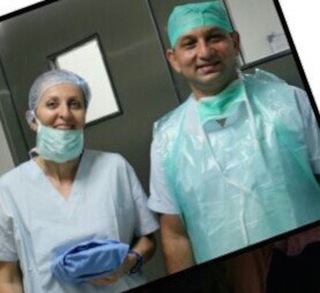
Midwife Lina Duncan and Dr Ameet Dhurandhar with a box containing a mother’s ‘seeding gauze’ in Mumbai, India.
The risks of transmitting the ‘wrong’ kind of bacteria in the gauze seeding process are equivalent to the risks in vaginal birth, Dr Dominguez-Bello told me. In her study all women are tested for viral, bacterial or fungal infection and GBS and HIV. Toni Harman, who directed the film Microbirth, says that this issue raises interesting questions about the whole process:
“Since Microbirth this idea of swabbing caesarean babies has sparked the most debate, in particular the question of what would happen if a pathogen is transferred to the baby? If the mother is screened and a potentially harmful bacteria is found, what do we do then? Swab or not swab? Do the benefits of swabbing outweigh the risk of harmful bacteria, or vice versa? This question just goes to show there’s an urgent need for much more long-term research into all aspects of childbirth – research that could have major implications for our long-term health.”
Until Dr Dominguez-Bello’s findings are published, there is perhaps a need to proceed with caution, and certainly, the gauze seeding process should not be seen as a solution to the rising c-section rates. “The latest science suggests there could be other long-term health benefits of being born vaginally, for example hormonal or epigenetic changes”, Toni Harman explains, “So in my opinion, the swabbing of C-Section babies shouldn’t be viewed in any way as ‘better than’ or a ‘replacement to’ vaginal birth.”
The gauze seeding technique certainly raises many more questions than answers. The long term effects are unclear, nor is it known for how long after the birth it might be beneficial to try to transfer vaginal bacteria to the newborn. There is, of course, nothing to stop mothers having caesarean births from using the seeding their baby’s microbiome themselves, with or without the help of professionals, either at the birth or in the days that follow.
It’s worth noting perhaps, that there are also other ways in which the microbiome diversity of both vaginally and caesarean born babies can be improved upon, such as immediate skin to skin, not washing the newborn for as long after birth as possible (days or weeks), limiting contact with anyone but mum for the first hours and days, and exclusive breastfeeding for the first six months, to name but a few.
The limited amount we do know about the microbiome should perhaps also encourage us to renew our existing respect of the childbirth and to make sure we take the long view. As with much medical research, our focus on birth has been largely centred on ‘problem solving’ and pathology. We haven’t shone much light on what is good, or healthy, or important about the birth process. Perhaps it is time to start?
This article first appeared online in May 2015.

Postscript by the author, Oct 2015
Since writing this I have read the new book by Michel Odent, Do we need midwives?, in which he writes about ‘FER’, the foetus ejection reflex, a phenomenon in which the baby is born by a very quick second stage with no ‘active’ or ‘conscious’ effort to push. Odent suggests that – since FER most often occurs in very ‘hands off’ and physiological births, then perhaps this is how babies are ‘meant’ to be born – the most ‘natural’ way? He adds that many babies born in this way are born ‘in the caul’, and questions what this means for the microbiome:
He writes:
“The gauze-in-the-vagina technique, evaluated by Maria Gloria Dominguez Bello in Puerto Rico, is based on a simple idea. A gauze pad is placed in the vagina in order to collect bacteria-laden secretions. Then, right after the caesarean birth, the baby’s skin and mouth are gently swabbed. This technique is based on the assumption that human babies have been programmed for immediate colonisation by vaginal microbes. We have good reasons to challenge this assumption. I know from experience that when a birth is not socialised, when there have been no vaginal examinations during pregnancy and labour, and when the conditions for a real fetus ejection reflex are met, a ‘birth in the caul’ is comparatively common. When the bag of water remains intact, the first microbes met by the baby do not belong to the vaginal flora. We have good reasons to believe that birth in the caul was common before the socialisation of childbirth.
In all societies, there has always been a special interest in ‘caulbearers’. They are supposed to be destined for lives of good health, fame and fortune. There are impressive lists of famous people born in the caul. Is it not paradoxical that until now being born protected against vaginal microbes was auspicious, and that now doctors have decided to treat this as a kind of microbial deprivation?”
Odent clearly questions here whether we are sure we know what we are doing when we ‘seed the microbiome’. It might seem odd to add his words after an article that may well have encouraged you to consider using this technique in your own births. I do so merely to point out that, as far as the microbiome is concerned, there is much that we don’t know, and that we need to proceed with a curious open mind, rather than feel we have arrived at answers or conclusions.